

┌──(insider@thread)-[~]
└─$ cat summary.txt

A cyber correspondent from a major news outlet faced a wave of criticism after candidly mentioning they had only just learned what PHP was. The backlash will no doubt blow over, but it reveals a few vulnerabilities in the industry’s culture worth patching: technical gatekeeping, an undervaluing of communication skills, and a reluctance to admit that nobody knows everything.
What happened?
This week, two critical PHP vulnerabilities, collectively dubbed PHP2Shell, made headlines. Tracked as CVE-2026-109618 and CVE-2026-109619, the flaws, discovered by researchers from Calif, OpenAI and Wiz, allow pre-authentication remote code execution on affected systems.
It’s a story with plenty to talk about: the severity of the flaws, the role AI played in finding them, and the disclosure and exploitation timeline.
But amongst the coverage, a journalist candidly mentioned they hadn’t known what PHP was until the day before. For a minority of the cyber security community, that became the story.
Cyber security is a team sport, and we need to draft expert communicators
Journalists excel at surfacing cyber stories to the masses. Not everyone tuning in to the news is likely to be a web developer.
Computers are never the story: hacked computers can be replaced. The story is always the consequences: the data accessed, the human cost, the financial damage. It should be self-evident that this doesn’t necessarily require knowing what PHP is. It requires knowing who to ask and how to explain the answer.
Writing off communication skills
The industry is in the worst possible place to recognise a journalist’s skill. LLMs have shifted priorities in a sector that already undervalued written communication. Reporting is often an afterthought, increasingly automated and full of generic, templated findings, and many technical professionals struggle to tell the story of their findings without AI-generated waffle.
The same AI that appears to have diminished the value of writing is already reshaping technical roles: reversing malware, detection engineering, analysing incidents, conducting vulnerability research. Those who don’t value writing may soon find others don’t value their expertise.
There are no ‘unconventional’ backgrounds
It’s not just computer science or cyber security graduates who go on to have impactful cyber security careers. Pathways range from the arts, humanities and sciences to vocational training, self-taught hacking and career changes: whether that be engineers, teachers, pharmacists, midwives, police officers and, notoriously ballet dancers!
A personal favourite is the linguist turned malware reverse engineer. They described the parallels between attributing malware samples, such as a Russian-based threat actor imitating Chinese threat actors, as analogous to attributing literary works to their authors and copycats by prose, style, genre and imitation.
Technical enough?
A minority of the industry seem to have taken role-based access control a bit too far. Whilst there are a variety of roles and skillsets, undue attention can be paid to the categorisation between technical and non-technical roles.
Technical gatekeeping alienates people at both ends of the spectrum: those who put themselves in boxes, believing they can’t understand something, and those who never step back from the task in front of them to see the bigger picture.
Fear is a security failure
Creating a hostile environment for mistakes is a fundamental security failure. If people are afraid to report a potential phish, admit a data loss incident or ask a specialist for help, problems stay hidden. The same is true for cyber professionals.
Nobody can know everything
This is a PSA: in the AI age, just ‘knowing stuff’ is becoming a valueless domain. Knowing how to Google or touch-type were once in-demand skills too.
There are expert pen testers who know nothing about detection technologies, web developers who know nothing about operating systems, and reverse engineers who know nothing about network security.
There will always be someone to whom your knowledge is inadequate. To the mathematician, the AI security expert knows nothing about AI and the network engineer knows nothing about cryptography.
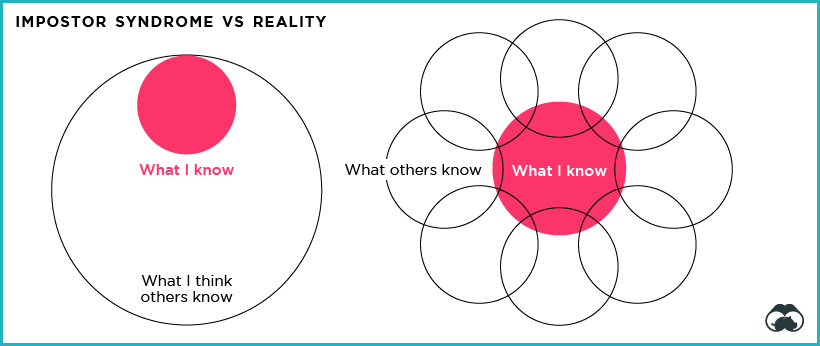
Many of the most knowledgeable professionals quietly grapple with imposter syndrome. One helpful mental model explains why: we compare what we know to the sum of everything everyone else knows, which can make us feel inadequate or unqualified. But we’re never comparing ourselves to a real person.
Curiosity over knowledge
The cyber industry requires constant learning. New vulnerabilities, tools and techniques appear every day. The traditional incident responder learning cloud security, the security engineer securing agentic systems, the compliance team gearing up for quantum-safe cryptography: the most knowledgeable professionals are the ones still learning something new. What you knew five years ago is likely already out of date, and what you know today will be too.
If you’re the smartest person in the room, you’re probably in the wrong room.